Showing posts with label Berlin. Show all posts

Thursday, September 20, 2012

Book Launch - Ambivalent Spaces


02-portadaArquitectura.jpg 


Jorge Lizardi Pollock, Martin Schwegmann (Editors)
Ambivalent Spaces. Espacios Ambivalentes

Between 1928 and 1978, the so called “superblocks”, “superquadras”, “habitation units” "Plattenbauten" or “residenciales públicos” – among other names in different languages- were celebrated as instruments for the social progress of the urban slum dwellers. And indeed, the modern social housing projects took care of the housing necessities of the sectors impoverished by modernity. For politicians, architects and urban planners alike, the modern residential developments were a biopolitical utopia bring forth. If so, why these communities frequently turned into ghettos? How “superblocks” came to be a synonym of marginality, otherness and contempt? It is social housing a vain attempt of human transformations? For many scholars, the "projects" are just a colossal landscape of a Nation State failure. For others, what has terribly failed is the competence of architecture as a techne of social ordering.
”Ambivalent Spaces” offers a critical insight to the most significant urban laboratories of the Twentieth century. The essays – written by scholars from Germany, Puerto Rico, Argentina, and Poland, discussed and contrast historical experiences in cities as dissimilar as Berlin, San Juan, México, Istanbul, Santo Domingo, Leinefelde and Tirana. Differences between cities are as striking as their cultural contexts. But researchers agree in what Dr. Florian Urban – one of the authors – concluded: "housing estates are an ambivalent heritage". To revisit their historical concepts and architectural designs is a way of learning in present what in the past we could not about the paradoxes of modernist urbanism. (Jorge Lizardi/ Martin Schwegmann)
[english/spanish]


Ediciones Callejón, 2011, 9781881748823
EUR 20.00

Order: http://www.pro-qm.de/ambivalent-spaces-espacios-ambivalentes

The book was launched at pro-qm bookshop in Berlin June 19th 2012 by Francisco Javier Rodríguez, Dean, University of Puerto Rico School of Architecture, and the editors Jorge Lizardi Pollock and Martin Schwegmann.   

Friday, March 16, 2012

Gefühlte Stadt - gefühlte Schrumpfung?

21.03.2012
Phänomenologische Perspektiven auf schrumpfende Städte
english below, but input and discussion in German only

Gespräch im Rahmen der Reihe Grenzgänger des Georg Simmel Zentrums für Metropolenforschung/Graduates Studies Group

Ort: Mohrenstraße 41, Raum 415 Zeit: 19:00 Uhr

Impuls: Lars Frers und Tore Dobberstein (complizen Planungsbüro

Moderation: Martin Schwegmann (GSG)

Konzeption: Inga Haese und Martin Schwegmann 


Schrumpfende Städte werden von allen Seiten beforscht - immer mit dem Hinweis, dass Schrumpfen endlich positiv bewertet werden muss (z.B. "Shrink Smart!"). Aber was macht das Abwesende eigentlich mit der Stadt und den Menschen? Häuser, die dem Erdboden gleichgemacht wurden, Geschäfte, die leerstehen oder Hafenbecken, die verwaisen… Diese Leerstellen müssen mit Sinn gefüllt werden. Und aus der Notwendigkeit des Füllens bezieht das Abwesende seine Kraft: Das, was fehlt, wird mit den Erinnerungen und Emotionen derer angefüllt, die es vermissen. Wird die schrumpfende Stadt so zu einem Ort, dessen Fülle aus jenem schöpft, die ihn erfahren haben - und zu einem Ort, der leer bleibt, wenn keine Erinnerungen und Emotionen mit ihm verknüpft sind?
Lars Frers will mit seinem Beitrag "zurück zu den Sachen selbst“ (Husserl). Er gibt einen Überblick über phänomenologische Stadtforschung und subjektives Raumerleben. Tore Dobberstein schildert seine Erfahrungen über Interventionen in schrumpfenden Städte aus der Perspektive des Praktikers. Complizen Planungsbüro (Halle/Berlin) hat insbesondere Erfahrungen gesammelt in der Umnutzung bestehender und oftmals leerstehender Architekturen und Stadtflächen (sportification).

Text von www.graduatesstudiesgroup.blogspot.com 

21.03.2012 
Felt City - Felt Shrinkage?
a phenomenological perspective on shrinking cities

Discussion within the Series Grenzgänger of Georg Simmel Centre of Metropolitan Studies/Graduates Studies Group 

Place: Mohrenstraße 41, Room 415 Time: 19:00 Uhr

Impuls: Lars Frers and Tore Dobberstein (complizen Planungsbüro

Moderation: Martin Schwegmann (GSG)

Conception: Inga Haese und Martin Schwegmann 

There is extensive research on Shrinking Cities from a wide range of perspectives always with the hint that they have to be finally getting evaluated in a positive way (e.g. "Shrink Smart!"). But what does the absent do to the city and to the people? Houses that are torn down, empty shops, or abandoned habour basins. These voids need to be filled with meaning. Through the necessity of filling it the absent recieves its strengh: The missing thing gets filled by emotions and emotions of those, that miss it. Is the shrinking city becoming that is gaining strengh of those, that have experienced it or is it become a place which remains empty if no memory and emotion is linked to it?
Lars Frers will go "back to the things themselves" (Husserl). He will give an overview over phenomelogical urban reserach and subjective spatial experience. Tore Dobberstein will share his experience from his practical intervening on shrinking cites. Complizen Planungsbüro (Halle/Berlin) has extensice experince in reusing and recoding existing often empty architecures and city scapes (sportification).

Text translated according to www.graduatesstudiesgroup.blogspot.com

Sunday, October 23, 2011

RETHINK BERLIN - UP SIGNS POSITION PAPER


The initiative STADT-NEUDENKEN (Rethink the city - of Berlin) has drafted a position paper which wants to promote a new way of dealing with public owned real estate in Berlin (Liegenschaften).

At the moment and for the last 10 years, the Liegenschaftsfond Berlin is the institution administrating and marketing the city owned real estate properties. So far the policy was to sell everything for the highest prize possible. After ten years it realzied 2.6 billion Euros in selling city owned properties. But Berlin has some 62 billon Euro depts. So it seems not realistic that the selling of the city owned real estate can contribute significantly to any substantial debt relief of the city. Under this circumstances especially it becomes obvious that a more farsighted and sustainable policy is urgently needed, which looks at use concepts for public real estates which are local and long lasting, interesting, experimental and thus can develop something which cannot be foreseen. We strongly support this position paper and want to encourage the new city government to go for a daring city policy and local approach which would possibly maintain the special character of the city better than any "Be Berlin" campaign!

Urban Passion, October 2011

Wednesday, September 21, 2011

The plants are restless - The future of a market garden in Berlin


Hilmar Poganatz (Journalist) and Martin Schwegmann (Architect, Urbanist) have published an article in the second issue of the magazin "THE Weekender", Magazin for insights and excursions.

The former districts market garden in Berlin-Lichtenberg runs wild since 2006. Its future is uncertain. Will its potentials for a sustainable development of the city be used or will it be sold for yet another housing development. On a visit in a contested Jungle amidst the great city.

Die ehemalige Bezirksgärtnerei von BERLIN-LICHTENBERG wildert seit 2006 vor sich hin. Ihre Zukunft ist ungewiss. Wird das potential zur nachhaltigen Entwicklung genutzt werden können, oder wird es verkauft und für noch eine Wohnunganlage genutzt?  Zu Besuch in einem umkämpften Dschungel inmitten der Großstadt.

Wednesday, September 14, 2011

From Sulukule to Kreuzberg

„Von Sulukule nach Kreuzberg: Vertreibung in Istanbul – Umstrukturierung in Berlin.Wenn die Stadtentwicklung profitgierige Wirtschaftsinteressen und Vertreibung heißt, dann… 

"From Sulukule to Kreuzberg: Eviction in Istanbul - restructuring in Berlin. If urban development means greed for profit and evivtion, than..."

Organized by Mehmet Bakir, Sinje Kätsch, Figen Izgin (Almende e.V.)

with the kind support of KOTTI, Verdi, IG Metall and sponsering of Rosa Luxemburg Stiftung.  


Veranstaltungsdatum/Date
Dienstag, am 31.05.2011, um 19.00h,
 
Veranstaltungsort/Place
Familiengarten, Oranienstr. 34, 10999 Berlin


Die Veranstaltung „Von Sulukule nach Kreuzberg" soll die Bewegung gegen die voranschreitende Vertreibung und Umstrukturierung in den beiden Großstädten Istanbul und Berlin thematisieren und zu Wort kommen lassen.
Es werden, neben den inhaltlichen Beiträgen zur Problematiken in den beiden Städten und zum Thema; Wohnen in Würde, sowohl die sozialen Bewegungen gegen Vertreibung aus Istanbul sowie Vertreter_in der Stadtteilinitiative(n) aus Berlin u.a. ihre Arbeit vorstellen.

Wir wollen möglichst breit einladen, möglichst verschiedene, an dieser Thematik interessierte und betroffene Menschen zusammenbringen, um eine größere Vernetzung und Solidarität untereinander anzuregen.


Referenten und Referentinnen - Die Themen

· Sebastian Jung, Sprecher der Initiative „Berliner Bündnis Sozialmieter.de“ gegen  Umstrukturierung wird aktuell über die Situation in Berlin und die tendenzielle Entwicklung, sowie schwerpunktmäßig über die Arbeit und das Engagement verschiedener Berliner Basisgruppen berichten.

· Dipl. Ing. Architekt Martin Schwegmann; forscht seit 2008 über den urbanen Transformationsprozess in Istanbul. Er wird einen Überblick über die Entwicklung seit 2000 und über die aktuelle Situation in Sulukule geben.

·Der in Berlin lebende Journalist Mehmet Bakir wird über die politischen Hintergründe der Stadtentwicklung in Istanbul referieren.

·Dr. Dorothee Haßkamp von Amnesty International wird die Kampagne "Wohnen in Würde" und Menschenrechte, Themengruppe wirtschaftliche, soziale und kulturelle Rechte, vorstellen und das Thema Menschenrecht in dieser Beziehung und die Arbeit  dazu darstellen.

·Es wird der Kurzer Dokumentarfilm über Sulukule des Filmemachers Ede Müller, „Sulukule Roman Orchestra“ gezeigt. Er selber wird anwesend sein und kurz über den Film und als Augenzeuge berichten.

·Die Veranstaltung wird von der Vertreterin von Allmende e.V., Frau Figen IZGIN, moderiert.

·Der zweite Teil der Veranstaltung soll Raum geben für Fragen, Diskussionen und Überlegungen für eine größere Vernetzung innerhalb Berlins und einer Solidarisierung u.a. mit den Roma in Istanbul und auch in Berlin.

·Begleitet wird die Veranstaltung von einer Foto und Plakatausstellung zu Sulukule / Kreuzberg und ihren jeweiligen Basisbewegungen und ihrer Aktionen.


ZUM THEMA

Dadurch wollen wir erreichen, dass die Gruppen, die zu diesem Thema aktiv sind, wenn auch mit unterschiedlichen Hintergründen, voneinander erfahren und lernen, Gemeinsamkeiten erkennen und diese Erfahrungen in ihre weitere Arbeit einfließen lassen.

Die Roma sind derzeit als Hauptbetroffene der Vertreibung aus Sulukule in Istanbul. Das Problem ist allerdings größer und nicht nur eine Roma Frage. Vor kurzem ist es in Istanbul beschlossen und geplant worden, dass ca. 1.000.000 Häuser / Wohnungen abgerissen sollen und weiteren Glaspaläste auf die Wohnviertel, wie denen der Roma in Sulukule, zu pflanzen. Die Menschen werden in Stadtrandbezirke vertrieben, in denen sie aus dem Nichts die eigene Existenz erhalten müssen.
Berlin dagegen ist eine Mieterstadt und die Mieten steigen in vielen Stadtteilen explosionsartig: Die Beruhigungspille, Wohnen in Berlin sei im Vergleich zu München oder Hamburg viel günstiger, hilft Menschen, die ihre Wohnungen verlassen müssen, deren Zahl stetig steigt, nicht weiter. Die rapide Erhöhung der Mieten verdrängt Menschen an den Rand der Stadt. Arme, Alte, Alleinerziehende und Migrant_innen werden gezwungen ihre Kieze zu verlassen. Ihre vertrauten Lebensräume übernehmen die gut verdienenden Akademiker. 
Seit Jahren steigt in Berlin die Nachfrage nach Wohnraum. In den letzten zehn Jahren ist die Anzahl der Haushalte rund um 130.000 gestiegen. Diese Entwicklung wurde seitens der Politik lange ignoriert: Das Angebot konnte mit der Nachfrage nicht mithalten: Seit Jahren stagniert der Wohnungsbau. Sozialwohnungen wurden verkauft.
Ein weiterer Grund der Mietsteigerung ist die Aufwertung der Kieze durch Sanierung der Häuser. Bestimmte Stadtteile werden so in Wert gesetzt. Hinzu kommt die Kündigung der Anschlussförderung für 28.000 Wohnungen berlinweit. Nachdem werden aus der Anschlussförderung immer mehr Miet- in Eigentumswohnungen umgewandelt. Wohnungen in Kreuzberg im Fanny-Hensel-Kiez oder in der Kochstraße bilden hier nur zwei Beispiele. Für die 44 Wohnungen im Fanny-Hensel-Kiez hat der neue Eigentümer nach dem Wegfall der Wohnungsbauförderung vor fünf Jahren die Warmmiete von 5,33 Euro auf 7,04 Euro pro Quadratmeter erhöht (32 Prozent, ganz legal).
Auch die steigende Nutzung von Wohnraum für Ferienunterkünfte treibt die Mieten hoch. Laut dem Wohnungsmarktbericht 2010 der Investitionsbank Berlin (IBB) ist von weiterem Anstieg der Mieten auszugehen. Auch hier wirken prinzipiell die gleichen Strukturen: die profitgierige Wirtschaftsinteressen.
Wenn schon die Wirtschaftsinteressen überall so wirken, so sollten es auch die Basisbewegungen in ihre Gegenstimme zur Wirkung bringen und sich mit denen in anderen Ländern verbunden fühlen.


Sunday, September 11, 2011

Stadtsafari 2010

participatory youth project initiated by nomadisch grün/prinzessinnen gärten
07-11.2010


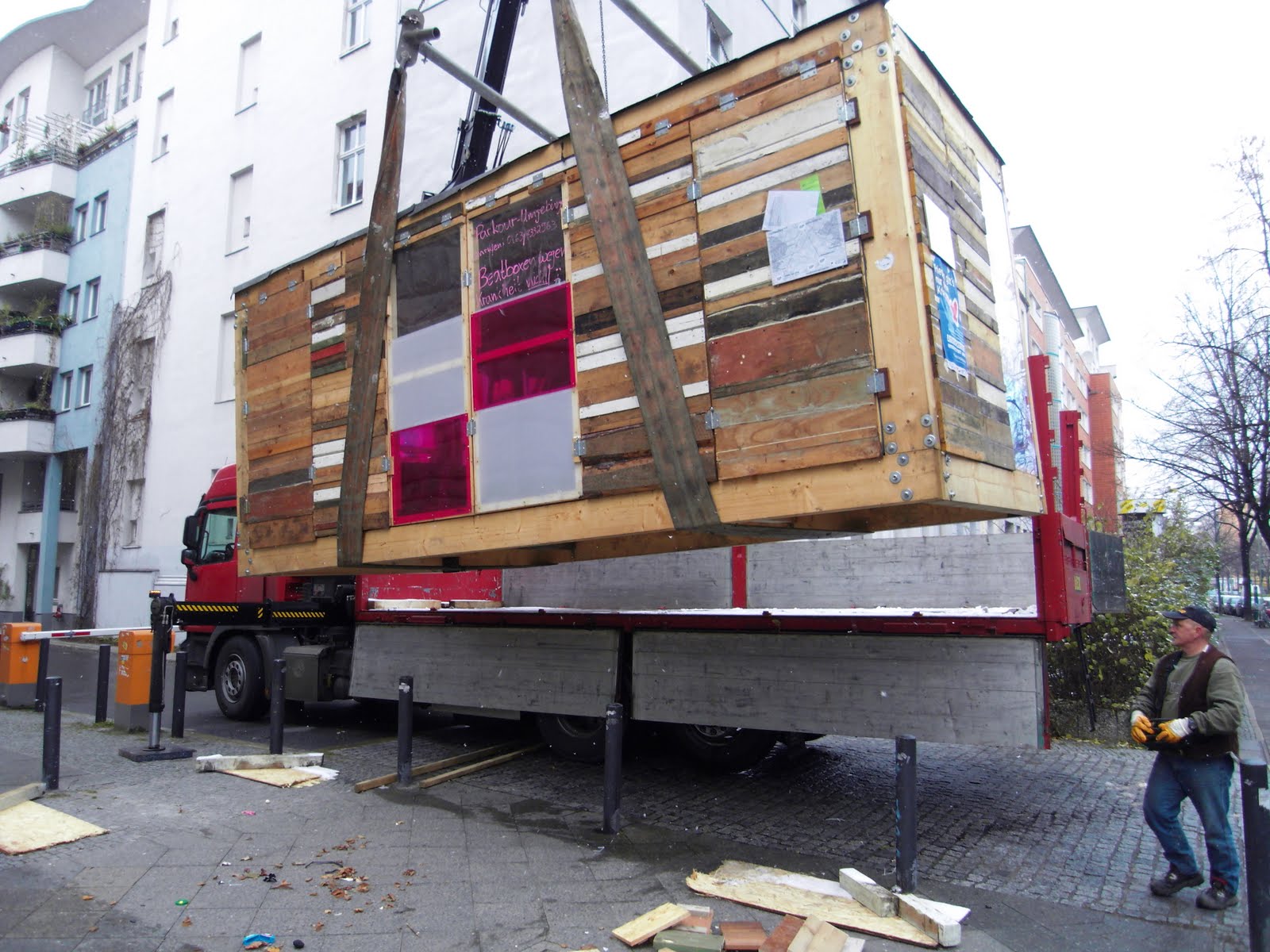
Stadtsafari 2010 was a participatory youth project within the framework of the ExWoSt scheme of the Federal Institute for Research on Building, Urban Affairs and Spatial Development. The project was conceptualized and initiated by nomadisch grün (g)Gmbh - the makers of Prinzessinnengärten, a well known urban gardening project in Berlin, Kreuzberg.

The idea was to find a way of involving young grown-ups actively into the shaping of their neighborhood, their city - to show that the city is something they can involve in actively. The catalysator or tool for interaction and involvement was a mobile youth club in the shape of a self build container made in the measurements of a standard office container made out of a wooden frame structure.


In order to connect to young people in the neighborhood of Moritzplatz in Kreuzberg, Berlin, we contacted both formal and informal institutions such as schools, sport clubs, theater initiatives, a skater group, the street university and many more.
                                                         photo: m.clausen

The project team:
Bianca Schemel, Documentation
Christobal Muhr, Construction Expert
Esra Cosansu, Junior Guide
Florian Walter, Construction Expert 
Inci Güler, Cultural Coordination and Programming
Jascha Vogel, Construction Expert
Jonathan Aikins, Junior Guide
Julia Schumann, Assistant
Julian Arons, Construction Expert
Marco Clausen, Manager nomadisch grün
Martin Schwegmann, Project Leader
Mary Njeri, Junior Guide
Okan Akogul, Junior Guide
Philipp Farmer, Construction Expert
Rob Andjelkovic, Junior Guide
Robert Shaw, Manager nomadisch grün
Rosmarie Köckenberger, Project Leader
Sasun Sayan, Junior Guide

Monday, January 24, 2011

Quartier für Vielflieger - Nests for the Frequent Flyers

http://quartierfurvielflieger.blogspot.com/

by Secil Yaylali and Anne Deschka, from May to October 2010, in Berlin/Kreuzberg*


Quartier für Vielflieger/Nests for frequent Flyers was a participatory public art project realized in 2010 the neighborhood Kreuzberg in Berlin.We invited inhabitants of the area to show their hospitality to migratory birds by building individual bird houses.


In Turkey and its neighboring countries, bird houses enjoy a century-long tradition. These tiny but highly decorated houses were constructed on the facades of public buildings as one of the typical architectural features. Within the striving urban life they should protect birds from adverse weather conditions and hungry cats. Inhabitants of those shelters often are migratory birds, which spent each winter in warmer regions. As temporary guests people welcomed them in a friendly way - a carrying human gesture towards the free migrants of the sky.


Also around the Kreuzberg- Kottbusser Tor, people - like migratory birds - are sharing the experience of departing and arriving, and the experience of being dependent on sharing the hospitality of other human beings.

According to old tradition from Turkey, we wanted to show the hospitality to the frequent visitors of the area. We also wanted to build a link between people and some associations in the area. We structured the project in 3 phases;

1) We made -one day events- by 5 local associations to inform more participants about the 2nd phase. We had an origami, water marbling, participatory drawing workshop and a lecture about the Turkish birdhouses and an excursion in Kreuzberg to be able to see which immigrant birds live in the area. This process also created a link among local associations in the area.


2) The second phase was the core of the project. It integrated 2 different workshops. One was a birdhouse-building workshop and the other one was a sound-editing workshop. The birdhouse-building workshop was a week long workshop and we organized 3 different groups of participant where participants could build their own birdhouses according to their own designs. The sound-editing workshop was a 1 week workshop that participants learnt about sound experienced with it.


3) In the end, a symposium, a film screening and an exhibition took place. The exhibition showed the products (the birdhouses-sound pieces) and the documentation of the project. In the symposium there was a screening of documentary movies about home land and a discussion about migration and hospitality. We also presented our publication in the end of the events.


The birdhouses were placed around Kottbuser Tor, Kreuzberg.


Events: Origami & Marbling (Ebru), participatory painting Workshops, Excursion, Lecture about traditional birdhouses, Birdhouse-building Workshops, Sound-editing Workshop, Symposium & Exhibition in Kreuzberg Museum

* in collaboration with 13 artists, 2 NABU Volunteers, a social worker, an architect, a social anthropologist and around 150 active participants in Berlin Kreuzberg

Friday, July 23, 2010

From Squatter to Real Estate Developer

Article in Biorama, Magazine for sustainable life with style
No 11 2010, published in Austria and Germany

Interview with Fabian Tacke,
Berlin based "alternative" real estate developer 
by Martin Schwegmann (Text) and Marcus Müller-Witte (Photo)  


Fabian Tacke, a former "squatter" in post wall east Berlin is now developing green housing projects in Berlin in which he combines profit with ecological and social sustainability. It seems that especially in times of difficult real estate markets, the green investment could gain popularity and leave its eco-niche. Could it just be a very reasonable investment? 

We asked him how he develops these projects and in how far his experiences with east Berlin post wall alternative housing projects play into his current work.  


More information under:


Social Entrepreneurship and Sustainable Urban Development in Berlin

Field trip of the Department of Urban Studies, University of Malmö, 8th -10th of may 2010


Urban Passion organized a three day field trip for about 40 scholars and practitioners from Sweden and Denmark. It consisted of three guided tours with expert tour guides, two workshops with Berlin based practitioners and researchers (The Hub Berlin; Simmel Center for Metropolitan Studies at Humboldt University). The trip was initiated and coordinated by Frederick Björn, researcher and teacher at Malmö University, Department of Urban Studies.


Subject:

Is it possible to reach urban sustainability through social innovation by the means of social entrepreneurship!?

This question was the starting point of the excursion. Because social entrepreneurship in the classical sense does not play a big role in urban development in Berlin in our opinion, we didn´t try to look for projects, places and actors which would call themselves social entrepreneurs in the first place. We rather wanted to show the group an
contested urban area, Media Spree, to start with. The idea was to look at a wide spectrum of actors, both institutional and non institutional, in order to see their relevance in the framework of sustainable urban development and social innovation.  The experiences and the expectancies where cross checked and broadened to other parts of Berlin in the workshops and additional field trips later on.

Social Entrepreneurship proved to be a little applied term in Berlin. The relevance in the Scandinavian context seems to be much higher and the involvement of institutional actors within button up urban development through small cultural and socially active actors (entrepreneurs) is much bigger. Yet the drive of button up actors in urban development in Berlin is still very strong, even though and maybe even because there is not really a comprehensive scheme for sustainable urban development integrating bottom up movements.  


Program:

Day 1:
- 3 City walks through the media spree area. 
- Workshop with Jürgen Breiter (The Hub Berlin, Wedding 
   Windows)  about the concept of social  
   entrepreneurship in Berlin

Day 2: 
- Site Visit of ExRotaPrint
   (Humboldt University Berlin): 
   sustainable urban development through social 
   entrepreneurship?*

Day 3:  
- Learning from Berlin? - Group meeting and final round up 
  of the field trip with Martin Schwegmann 

Routes of the different groups. (Guides: Carsten Joost, Anja Steglich, Yves Mikelsons-Roloff )                                                                                                                                                                                          


Workshop at meeting space of KUNSTrePUBLIK, Jürgen Breiter (THE HUB BERLIN)


Workshop at Simmel Center for Metropolitan Studies.
Prof. Harald Mieg (welcoming the groups participants)

Workshop participants/function: 
Prof. Harald Mieg, Spokesman of Simmel Center (introduction); Heike Oevermann, Member of Simmel Center (moderation); Martin Schwegmann, Member of Simmel Center (moderation)

Inputs: 
Mathias Heyden, Assistant Professor Technical University Berlin: What are our real values? Community design and participatory architecture as tools for urban sustainability
Paola Alfaro d´Alencon and Daniela Konrad, Assistant Professors Technical University Berlin: Introduction of their Urban Research Camp; Design Laboratory
-->Frederik Björk, lecturer at Malmö University: Introduction to the Concepts of Social Entrepreneurship in connection to sustainable urban development

Magnus Johansson, Assistant Professor at Malmö University: Social innovation and sustainable urban development
Lise Bisballe, lecturer at Roskilde University and social entrepreneur: Introduction of the project socialventures@2200 in Copenhagen
Thomas Bisballe, analyst for the city of Copenhagen: Public actors and the facilitation of social entrepreneurship - How to interact with "the opposition
Levend Kalac, Architect and Master Student, Fachhochschule Frankfurt: Urban development challenges - the case of Norra Sorgenfri
Prof. Björn Bjerke, -->Linnaeus University: Local governments with public entrepreneurs in focus


 Learning from Berlin? - Round up of the field trip at the Michelberger Hotel, Berlin


    Johannesburg24 at Bar25


 Skateboard Venue at RAW Temple


  On site explanation of the block structure of Berlin by Yves Mikelsons Roloff 


------------------------------------------------------

Reflections on the study trip from Karl Palmås: The ”post-productive” is the productive 

------------------------------------------------------

Wednesday, January 27, 2010

Sulukule Reality - Panel Discussion

21.11.2009, Naunynritze, Naunynstraße 63, Berlin Kreuzberg


in the framework of the music festival kreuztanbul III


host: Secil Yaylali

panellists:

Ede Müller, film-maker (video message), Berlin
Göksin Yaran, (translator) for Ede Müller, Istanbul
Funda Oral, Sulukule Platform, Istanbul
Martin Schwegmann, urban researcher and planner, Berlin
Sükrü Pündük, Roma Cultural Association Sulukule, Istanbul

Music: Mert Ustaoglu, Aytac Kiran, Yasin Kiran


photograph: Mehmet Bakir


photograph: Mehmet Bakir

Martin Schwegmann, Funda Oral, Secil Yaylali                     

Sulukule, located on the historic peninsular of Istanbul, is - or better was - one of the oldest Roma settlements in the world. A few years ago, Fatih municipality declared Sulukule a “collapsed” area and began an urban transformation project according to new laws. The project included the construction of luxury houses in the neighbourhood and the transfer of local Roma, many of them home owners, to apartments in the distant (56km) Taşoluk neighbourhood belonging to Istanbul’s Arnuvutköy district.


Martin Schwegmann and Marcus Müller-Witte went for field research to sulukule and tasoluk in 2008 and 2009

The urban transformation project caused an angry reaction from Roma and civil society organizations, who decried both the transfer of the population to an alternative location whose conditions were incompatible with their lifestyle. From Sulukule, 340 families moved to Taşoluk yet only six remained there; all others returned to Balat, a neighbourhood close to Sulukule.

The panel explained the current situation in Sulukule from the various points of view of the panellist.


photographs: Mehmet Bakir


photograph: Mehmet Bakir
 
Roma musicians rehearsing during the panel