Showing posts with label simmel centre. Show all posts

Sunday, April 28, 2013

Internationale Sommerschule Berlin / San Juan, Puerto Rico (USA)


Urbane Pioniere und informelle Stadtentwicklungsstrategien sind Thema eines internationalen Sommerworkshops, der in Kooperation mit der Tempelhofer Freiheit in Berlin, der Universidad de Puerto Rico und dem Georg Simmel Zentrum für Metropolenforschung der Humboldt Universität stattfindet. Mit dieser Thematik beschäftigen sich 16 Studierende aus San Juan für zwei Wochen im Juni 2013. Die Universität ist mit ca. 63.000 Studierenden eine der größten Universitäten der Karibik.

Exkursionen, Vorträge von Fachleuten sowie der direkte Kontakt zu Pionieren und  Anwohnerinnen und Anwohnern dienen als Basis für die studentischen Arbeiten.  Der Schwerpunkt des Sommerworkshops liegt in der Fragestellung nach der sozialen, kulturellen und ökonomischen Relevanz von Pioniernutzungen und temporären Aneignung von Stadtraum für die Stadtentwicklung.

Berlin ist bekannt für besondere Orte und dem originelle Umgang mit Gebautem. Viele Gäste sind fasziniert von Berlins Clubs, urbanen Gärten und den künstlerischen Aktionen in der Stadt. Vor diesem Hintergrund suchen die Gäste nach sozialen, kulturellen und unternehmerische Innovationen, auch mit dem Hintergedanken mögliche Erkenntnisse und Ideen in der Heimat später selbst anzuwenden oder umzusetzen.

Gearbeitet wird unter anderem im „Recyclinggebäude Plattenvereinigung“ auf der südlichen Taxi-Fahrbahn neben der Skateanlage Vogelfrei. Das Gebäude dient als „Studienobjekt und Werkstatt für Lehrbaustellen, Seminare und Vorträge, fachliche Forschung, Theater- und Kunstprojekte sowie Workshops und weitere öffentliche Formate im Sinne einer sozial-ökologischen Bildung und Kommunikation.“

Der Begegnungsraum aus wiederverwendeten ost- und westdeutschen Plattenbauteilen ist ein idealer Standort für die Besuchergruppe. Auf Ihrer Exkursion setzten sich die Gäste aus Puerto Rico auch mit der Bedeutung der einzigartigen Berliner Geschichte für aktuelle Herausforderungen in Stadtentwicklung und Baukultur auseinander.

Organisiert wird der Summer Workshop von Tore Dobberstein und Martin Schwegmann im Rahmen des Netzwerkes für Stadtentwicklung, Forschung und Kommunikation - URBAN PASSION.

Thursday, September 20, 2012

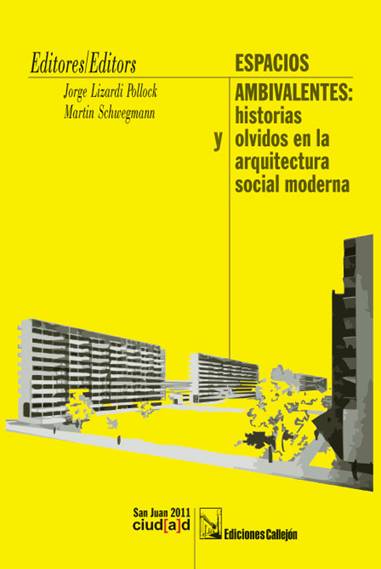
Book Launch - Ambivalent Spaces


02-portadaArquitectura.jpg 


Jorge Lizardi Pollock, Martin Schwegmann (Editors)
Ambivalent Spaces. Espacios Ambivalentes

Between 1928 and 1978, the so called “superblocks”, “superquadras”, “habitation units” "Plattenbauten" or “residenciales públicos” – among other names in different languages- were celebrated as instruments for the social progress of the urban slum dwellers. And indeed, the modern social housing projects took care of the housing necessities of the sectors impoverished by modernity. For politicians, architects and urban planners alike, the modern residential developments were a biopolitical utopia bring forth. If so, why these communities frequently turned into ghettos? How “superblocks” came to be a synonym of marginality, otherness and contempt? It is social housing a vain attempt of human transformations? For many scholars, the "projects" are just a colossal landscape of a Nation State failure. For others, what has terribly failed is the competence of architecture as a techne of social ordering.
”Ambivalent Spaces” offers a critical insight to the most significant urban laboratories of the Twentieth century. The essays – written by scholars from Germany, Puerto Rico, Argentina, and Poland, discussed and contrast historical experiences in cities as dissimilar as Berlin, San Juan, México, Istanbul, Santo Domingo, Leinefelde and Tirana. Differences between cities are as striking as their cultural contexts. But researchers agree in what Dr. Florian Urban – one of the authors – concluded: "housing estates are an ambivalent heritage". To revisit their historical concepts and architectural designs is a way of learning in present what in the past we could not about the paradoxes of modernist urbanism. (Jorge Lizardi/ Martin Schwegmann)
[english/spanish]


Ediciones Callejón, 2011, 9781881748823
EUR 20.00

Order: http://www.pro-qm.de/ambivalent-spaces-espacios-ambivalentes

The book was launched at pro-qm bookshop in Berlin June 19th 2012 by Francisco Javier Rodríguez, Dean, University of Puerto Rico School of Architecture, and the editors Jorge Lizardi Pollock and Martin Schwegmann.   

Monday, June 22, 2009

Workshop :"SPACES AND IDEAS -Urban Utopias and Realities from Latin America to Eastern Europe"

20th of june 2009, georg simmel center of metropolitan studies, berlin

Utopias of modernism between Latin America and Eastern Europe: How do they look and what has become of them? In the framework of the GSZ workshop “Spaces and Ideas” on June 20th, different urban utopias got revisited and compared. Prof. Jorge Lizardi-Pollock, an architectural historian of the university of Puerto Rico, focuses on the development of city renewal from the 1930s to the 1960s in Latin America, especially in Mexico and the Caribbean. The town planner Florian Koch (University of Applied Sciences, Erfurt) describes the archetypical construction of the “socialist city” and shows the realities of socialist urban development by looking at assorted Eastern European cities. In the last lecture Joanna Kusiak (University of Warsaw, Philosophy, Sociology) analyses the specific condition of South-East European urban development as a result of the immediate availability of the city for dictatorships. The workshop was moderated by Martin Schwegmann, Architect and Urban Researcher. Download Program