Last Call: Teams consisting of three members – representing the cultural
sphere/civil society, public sector and business – are invited to apply
with their project idea online.
Applicants can come from all cities in
the 47 Council of Europe Member states plus Belarus and Kosovo. Please
find all infos, the link to the application form and the FAQs at http://ow.ly/RH9Vd
The initiative STADT-NEUDENKEN (Rethink the city - of Berlin) has drafted a position paper which wants to promote a new way of dealing with public owned real estate in Berlin (Liegenschaften).
At the moment and for the last 10 years, the Liegenschaftsfond Berlin is the institution administrating and marketing the city owned real estate properties. So far the policy was to sell everything for the highest prize possible. After ten years it realzied 2.6 billion Euros in selling city owned properties. But Berlin has some 62 billon Euro depts. So it seems not realistic that the selling of the city owned real estate can contribute significantly to any substantial debt relief of the city. Under this circumstances especially it becomes obvious that a more farsighted and sustainable policy is urgently needed, which looks at use concepts for public real estates which are local and long lasting, interesting, experimental and thus can develop something which cannot be foreseen. We strongly support this position paper and want to encourage the new city government to go for a daring city policy and local approach which would possibly maintain the special character of the city better than any "Be Berlin" campaign!
participatory youth project initiated by nomadisch grün/prinzessinnen gärten
07-11.2010
Stadtsafari 2010 was a participatory youth project within the framework of the ExWoSt scheme of the Federal Institute for Research on Building, Urban Affairs and Spatial Development. The project was conceptualized and initiated by nomadisch grün (g)Gmbh - the makers of Prinzessinnengärten, a well known urban gardening project in Berlin, Kreuzberg.
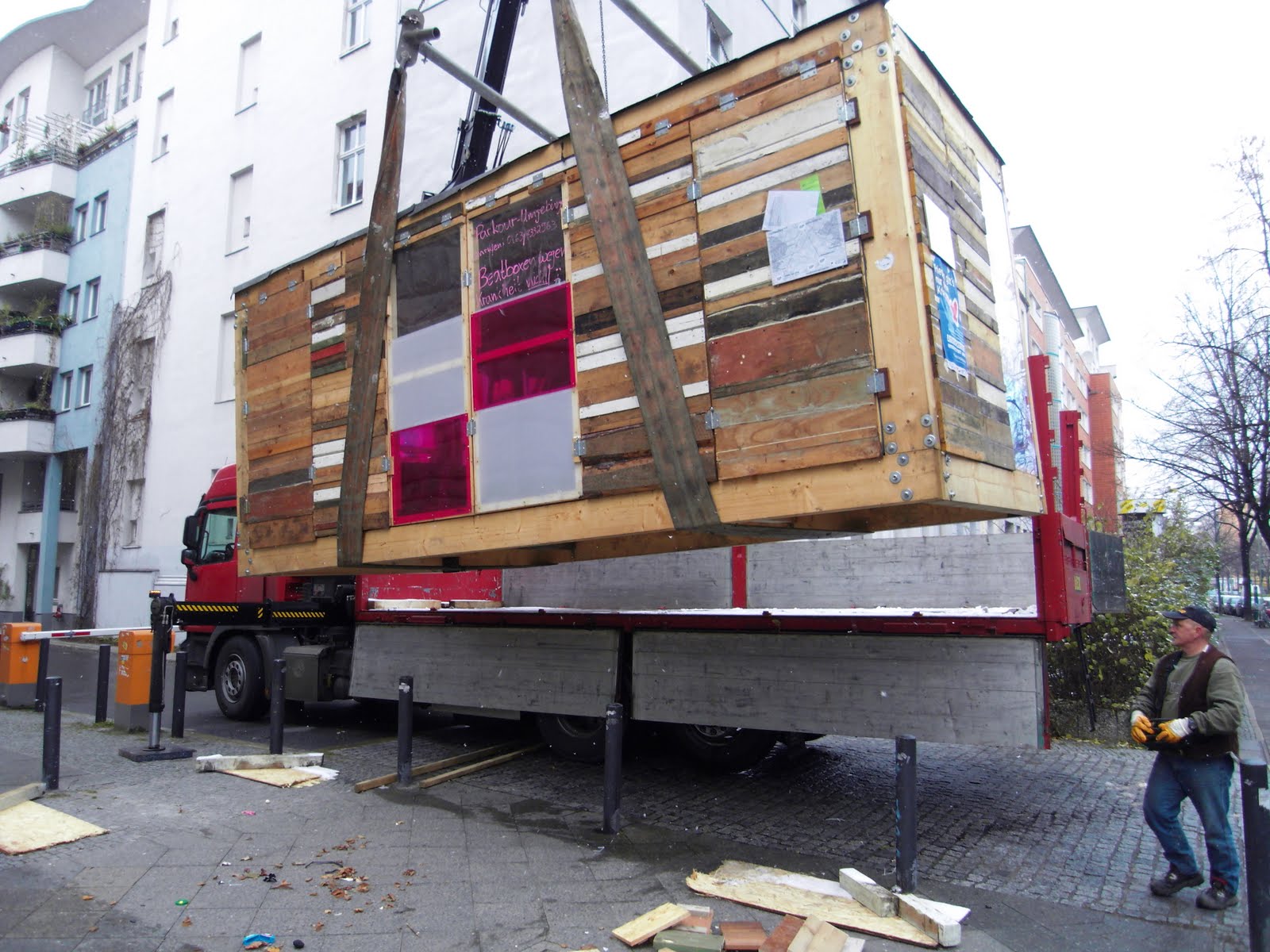
The idea was to find a way of involving young grown-ups actively into the shaping of their neighborhood, their city - to show that the city is something they can involve in actively. The catalysator or tool for interaction and involvement was a mobile youth club in the shape of a self build container made in the measurements of a standard office container made out of a wooden frame structure.
In order to connect to young people in the neighborhood of Moritzplatz in Kreuzberg, Berlin, we contacted both formal and informal institutions such as schools, sport clubs, theater initiatives, a skater group, the street university and many more.
photo: m.clausen
The project team:
Bianca Schemel, Documentation
Christobal Muhr, Construction Expert
Esra Cosansu, Junior Guide
Florian Walter, Construction Expert
Inci Güler, Cultural Coordination and Programming
Jascha Vogel, Construction Expert
Jonathan Aikins, Junior Guide
Julia Schumann, Assistant
Julian Arons, Construction Expert
Marco Clausen, Manager nomadisch grün
Martin Schwegmann, Project Leader
Mary Njeri, Junior Guide
Okan Akogul, Junior Guide
Philipp Farmer, Construction Expert
Rob Andjelkovic, Junior Guide
Robert Shaw, Manager nomadisch grün
Rosmarie Köckenberger, Project Leader
Sasun Sayan, Junior Guide
by Secil Yaylali and Anne Deschka, from May to October 2010, in Berlin/Kreuzberg*
Quartier für Vielflieger/Nests for frequent Flyers was a participatory public art project realized in 2010 the neighborhood Kreuzberg in Berlin.We invited inhabitants of the area to show their hospitality to migratory birds by building individual bird houses.
In Turkey and its neighboring countries, bird houses enjoy a century-long tradition. These tiny but highly decorated houses were constructed on the facades of public buildings as one of the typical architectural features. Within the striving urban life they should protect birds from adverse weather conditions and hungry cats. Inhabitants of those shelters often are migratory birds, which spent each winter in warmer regions. As temporary guests people welcomed them in a friendly way - a carrying human gesture towards the free migrants of the sky.
Also around the Kreuzberg- Kottbusser Tor, people - like migratory birds - are sharing the experience of departing and arriving, and the experience of being dependent on sharing the hospitality of other human beings.
According to old tradition from Turkey, we wanted to show the hospitality to the frequent visitors of the area. We also wanted to build a link between people and some associations in the area. We structured the project in 3 phases;
1) We made -one day events- by 5 local associations to inform more participants about the 2nd phase. We had an origami, water marbling, participatory drawing workshop and a lecture about the Turkish birdhouses and an excursion in Kreuzberg to be able to see which immigrant birds live in the area. This process also created a link among local associations in the area.
2) The second phase was the core of the project. It integrated 2 different workshops. One was a birdhouse-building workshop and the other one was a sound-editing workshop. The birdhouse-building workshop was a week long workshop and we organized 3 different groups of participant where participants could build their own birdhouses according to their own designs. The sound-editing workshop was a 1 week workshop that participants learnt about sound experienced with it.
3) In the end, a symposium, a film screening and an exhibition took place. The exhibition showed the products (the birdhouses-sound pieces) and the documentation of the project. In the symposium there was a screening of documentary movies about home land and a discussion about migration and hospitality. We also presented our publication in the end of the events.
The birdhouses were placed around Kottbuser Tor, Kreuzberg.
Events: Origami & Marbling (Ebru), participatory painting Workshops, Excursion, Lecture about traditional birdhouses, Birdhouse-building Workshops, Sound-editing Workshop, Symposium & Exhibition in Kreuzberg Museum
* in collaboration with 13 artists, 2 NABU Volunteers, a social worker, an architect, a social anthropologist and around 150 active participants in Berlin Kreuzberg
Urban Passion organized a three day field trip for about 40 scholars and practitioners from Sweden and Denmark. It consisted of three guided tours with expert tour guides, two workshops with Berlin based practitioners and researchers (The Hub Berlin; Simmel Center for Metropolitan Studies at Humboldt University). The trip was initiated and coordinated by Frederick Björn, researcher and teacher at Malmö University, Department of Urban Studies.
Subject:
Is it possible to reach urban sustainability through social innovation by the means of social entrepreneurship!?
This question was the starting point of the excursion. Because social entrepreneurship in the classical sense does not play a big role in urban development in Berlin in our opinion, we didn´t try to look for projects, places and actors which would call themselves social entrepreneurs in the first place. We rather wanted to show the group an
contested urban area, Media Spree, to start with. The idea was to look at a wide spectrum of actors, both institutional and non institutional, in order to see their relevance in the framework of sustainable urban development and social innovation. The experiences and the expectancies where cross checked and broadened to other parts of Berlin in the workshops and additional field trips later on.
Social Entrepreneurship proved to be a little applied term in Berlin. The relevance in the Scandinavian context seems to be much higher and the involvement of institutional actors within button up urban development through small cultural and socially active actors (entrepreneurs) is much bigger. Yet the drive of button up actors in urban development in Berlin is still very strong, even though and maybe even because there is not really a comprehensive scheme for sustainable urban development integrating bottom up movements.
Workshop participants/function: Prof. Harald Mieg, Spokesman of Simmel Center (introduction); Heike Oevermann, Member of Simmel Center (moderation); Martin Schwegmann, Member of Simmel Center (moderation)
Inputs: Mathias Heyden, Assistant Professor Technical University Berlin: What are our real values? Community design and participatory architecture as tools for urban sustainability Paola Alfaro d´Alencon and Daniela Konrad, Assistant Professors Technical University Berlin: Introduction of their Urban Research Camp; Design Laboratory
-->Frederik Björk,lecturer at Malmö University: Introduction to the Concepts of Social Entrepreneurship in connection to sustainable urban development
Magnus Johansson, Assistant Professor at Malmö University: Social innovation and sustainable urban development Lise Bisballe, lecturer at Roskilde University and social entrepreneur: Introduction of the project socialventures@2200 in Copenhagen Thomas Bisballe, analyst for the city of Copenhagen: Public actors and the facilitation of social entrepreneurship - How to interact with "the opposition Levend Kalac, Architect and Master Student, Fachhochschule Frankfurt: Urban development challenges - the case of Norra Sorgenfri Prof. Björn Bjerke, -->Linnaeus University: Local governments with public entrepreneurs in focus
Learning from Berlin? - Round up of the field trip at the Michelberger Hotel, Berlin
urbanistic survey for former berlin wall area,
commissioned by the district Berlin Mitte
type: urbanistic survey, invited competition date: april to october 2008 content: development of a strategy and possible housing typology for a new quarter on the former no man´s land of the Berlin wall in Berlin Mitte (Centre) in the area of alte Jakobstraße and Alexandrienen Straße (near Metro Spittelmarkt) status: completed, 3rd place workgroup:KUNSTrePUBLIK, Urban Passion, ifau
In an urbanistic survey, commissioned by the municipality of Berlin/Mitte, we were invited to develop a new utilization and building concept for an area within the margins of the former death strip of the berlin wall between alte Jakob Straße, Alexandrinen- and Stallschreiber Straße. Within an interdisciplinary team of artists and architects we first organized interviews and talks with local inhabitants and external experts in an specially created vehicle. These talks formed a decisive basis of our proposal.
invited experts:
Klaus Overmeyer, landscape architect, urban catalyst studio, expert for bottom up planning
Horst Pfander, stattbau.de & Selbstbau Kreuzberg, expert for self-organized building
Winfried Härtel, Wohnprojekte-Berlin.info, expert for house builder groups
Berthold Becker, JonesLang LaSalle - Asset Management, expert for real estate development
Ralf Chille, TPA-berlin.de, Agentur für Quartiersmarketing, expert for place branding
Dr. Michael LaFont, id22, institute for creative sustainability, expert for alternative urban development
Christophe Kotanyi, AG-Kleinstlandwirtschaft und Gärten in Stadt und Land, expert for guerilla gardening and temporary uses
Alex Toland, Wrietzener Freiraumlabor Berlin, expert for guerilla gardening and temporary uses
The expert talks with their fruitful discussions created substantial input for our concepts.
Our key concepts: -development in phases, small parcels, -openness of identity = the possibility of experiments -necessity of a program jump start, an initial spark
-connected, and accessible green spaces with individual use
The mix of "formal" and "informal" uses should be given in order to start right away with a diverse multiplicity of players in order to give the place a rather unique profile.
What do we mean by formal and informal uses? Formal once are those which are rather permanent and need high investment such as housing. Less permanent and less investment intensive uses like gardening, temporary workspaces, cultural venues we see as informal uses. Less permanent refers to the character of the spacial intervention following the use. Nevertheless we regard these uses as very important to shape the original character of the quarter.
In order to give smaller investors the chance to build and
also to get a better mix of users, our concept foresees relatively small parcels and the development in phases, in order to avoid a permanent building site. The aim is, to complete intact parts. That makes a long development phase bearable.
Concerning a possible architecture for the area we developed relatively flexible floor plan solutions which facilitate multi family uses. We try to keep the green spaces as big, connected and accessible as possible within the tight framework of the task.
17.04.2008, 19:00 Uhr Stadtteilbüro, Warschauer Straße 23, Berlin
Lecture about the theory and practice of participatory urban development with Martin Schwegmann, Architect and Town Planner, urbanpassion
"Local players shape their city. The city becomes an open source code, which can be developed by everyone. By now this kind of city adds on to Berlin's image substantially. How can this development be maintained."
Within the framework of the jour fixe of wriezener freiraum labor, part of the research programme Experimental Housing and Urban Development (ExWoSt) of the Federal Ministry of Transport, Building and Urban Affairs (BMVBS)
Vortrag und Diskussion zu Theorie und Praxis partizipatorischer Stadtentwicklung
mit Martin Schwegmann, Architekt und Stadtplaner, urbanpassion
“Zunehmend gestalten lokale Akteure ihre Stadt. Die Stadt wird zum offenen Quellcode, an dem jeder mit entwickeln kann. Diese Stadt trägt in Berlin inzwischen wesentlich zum Image bei. Wie kann diese Entwicklung erhalten bleiben?”
Im Rahmen des Jour Fixe des Wriezener Freiraumlabors, Teil des Forschungsprogramms Experimenteller Wohnungs- und Städtebau "ExWoSt" des Bundesministeriums für Verkehr, Bau und Stadtentwicklung.




 Posts
Posts


